
Explore your power story
Your current bill
Understand your current situation, the charges on your statement, and what has changed over time.
- Your total bill depends on both the price of electricity and how much you use.
- Supply rates can change. Compare the same charge and dates when looking at history.
- Start with your utility, then open a real anonymized statement.
Know what is on your bill.
- Supply: the electricity you buy, from default service or a separate supplier.
- Delivery: the network that brings electricity to your home.
- Other charges: customer charges, taxes, adjustments, or separate services.
Duquesne Light is your delivery context here. Supply pays for electricity; delivery helps bring it to your home. Other charges may apply.
Follow the path to your home
One network. Millions of connections.
Follow the energy, then understand what you pay for.
- GenerationElectricity is producedSupply
- TransmissionHigh-voltage travelSupply / transmission
- SubstationVoltage steps downDelivery
- DistributionNeighborhood power linesDelivery
- TransformerVoltage for your homeDelivery
- Your meterRecords grid energyMetering / service
- Your homeElectricity you useUsage in kWh
The energy. Supply pays for electricity. Transmission carries it over long distances.
The connection. Delivery supports the neighborhood network. Customer charges and other adjustments can also apply.
Many generators feed a shared grid; power does not follow one dedicated route to your home. This simplified path explains the roles. Your statement may group the charges differently.
Our team handles the utility application and coordination. The utility reviews the interconnection and grants permission to operate. Follow the written approval and your project team’s startup instructions.
Read your utility solar information and interconnection processRead your bill
Read your bill, line by line.
Pick your utility. Each number on the sample bill matches a callout. Every bill is different, and your numbers will differ.
How to read your Duquesne Light bill
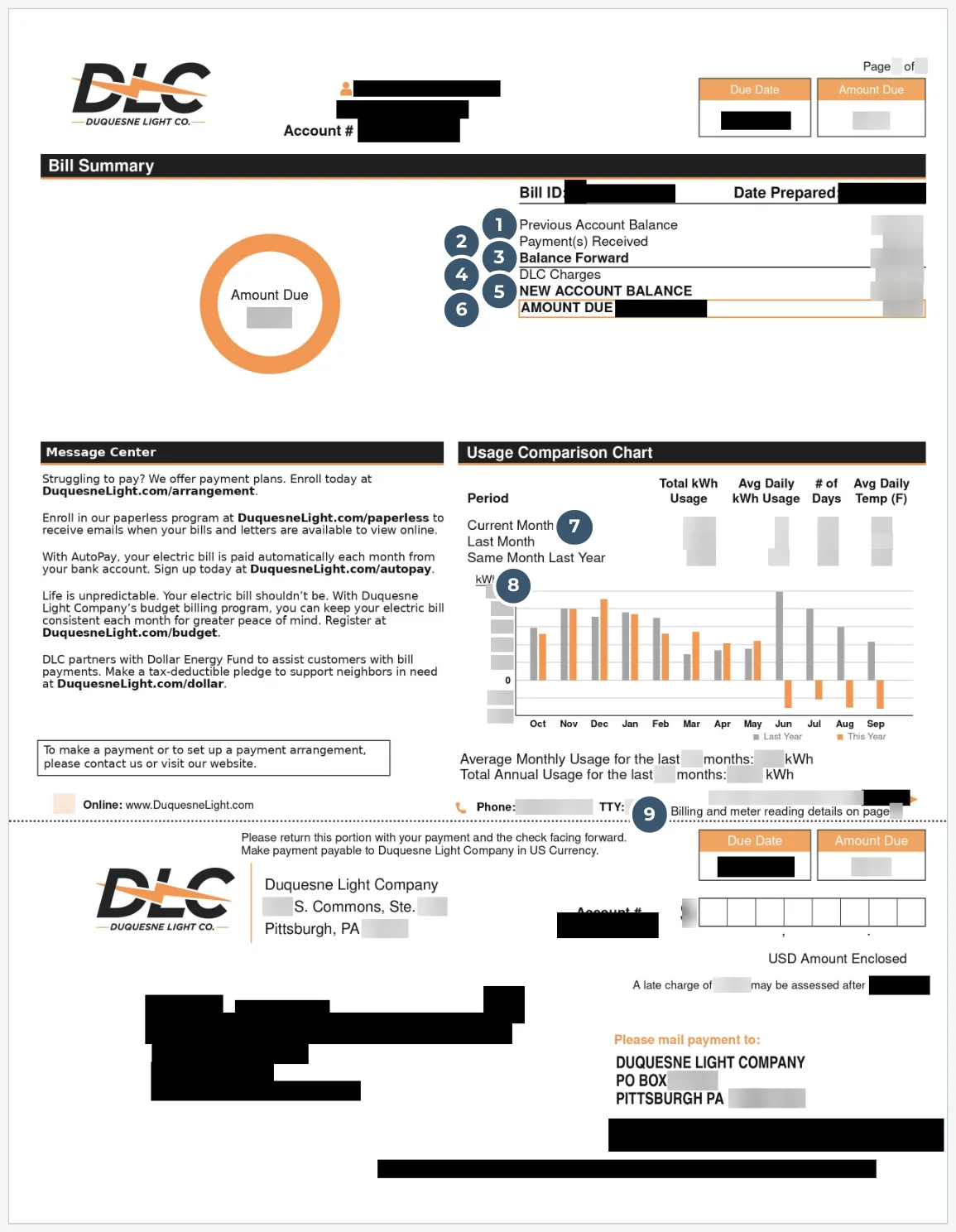
- Previous Account Balance
Where last month left off. A minus sign means a credit.
- Payment(s) Received
Payments made since the last bill.
- Balance Forward
What carries into this bill after payments.
- DLC Charges
This month’s Duquesne Light charges. Page 2 breaks them down line by line.
- New Account Balance
Balance forward plus this month’s charges. A minus sign means a credit is still left.
- Amount Due
What you owe this month. A credit balance can cover current charges.
- Usage this month
A negative number means the panels made more than the home used.
- Usage chart
Gray is last year, orange is this year. Bars below zero mean power sent back to the grid.
- Details on page 2
Flip the bill over. Page 2 shows the rate, the charges and your net metering bank.
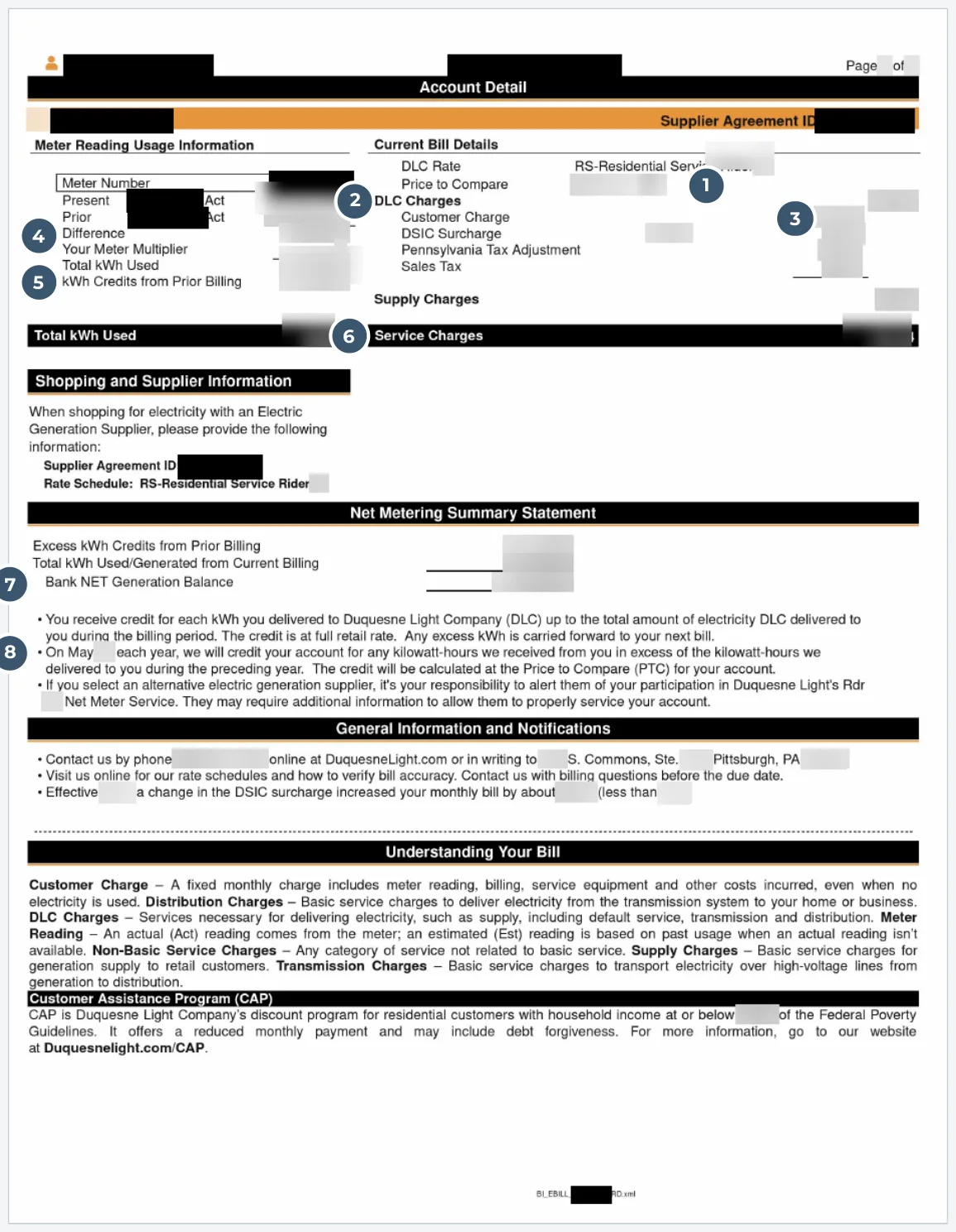
- Price to Compare
What Duquesne Light charges per kWh for power supply. This is the number to hold up next to a solar rate. Duquesne Light updates it on June 1 and December 1.
- DLC Charges (delivery)
Duquesne Light’s charges for bringing power over its wires. Net metering credits can offset kWh-based charges under your utility’s rules. The monthly customer charge stays.
- Customer Charge
A flat monthly fee. You pay it with or without solar.
- kWh used this month
A negative number means the panels made more than the home used.
- Credits from prior billing
Extra kWh from earlier months, carried forward.
- Service Charges
What this month’s charges add up to after credits.
- Net metering bank
Your running balance of extra kWh.
- Year-end credit
On May 31 each year, leftover kWh are credited at the Price to Compare.
How to read your West Penn Power bill
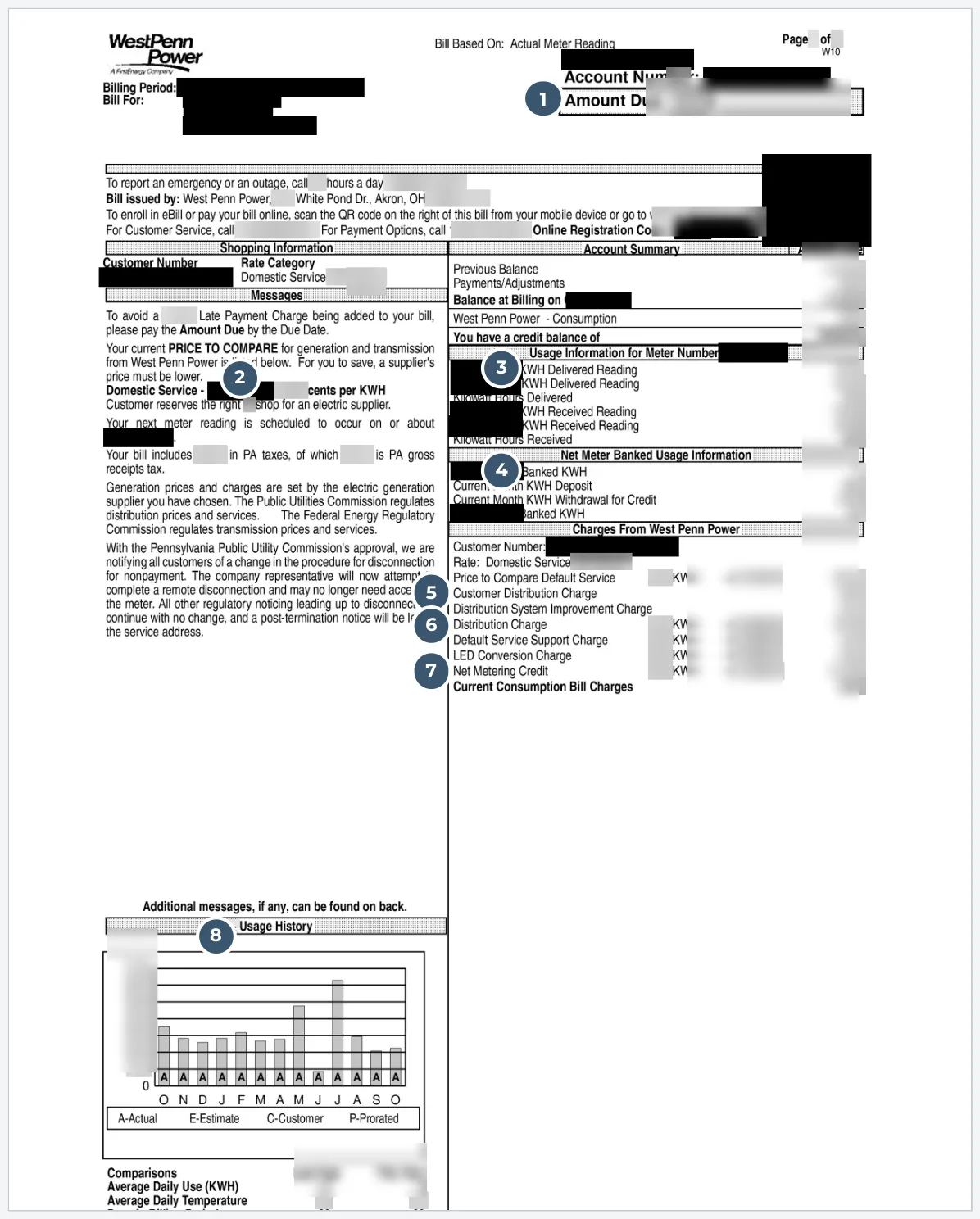
- Amount Due
What you owe this month.
- Price to Compare
What West Penn Power charges per kWh for generation and transmission. It updates on June 1 and December 1.
- Delivered vs. received
Delivered is power from the grid. Received is power your panels sent back.
- Banked kWh
Extra kWh saved for later months.
- Customer Charge
A flat monthly fee. You pay it with or without solar.
- Distribution Charge (delivery)
The per-kWh fee for bringing power over the utility’s wires. Net metering credits can offset kWh-based charges under your utility’s rules. The customer charge stays.
- Net metering credit
Your panels’ power taken off this month’s charges.
- Usage history
Twelve months of usage.
How to read your Penn Power bill
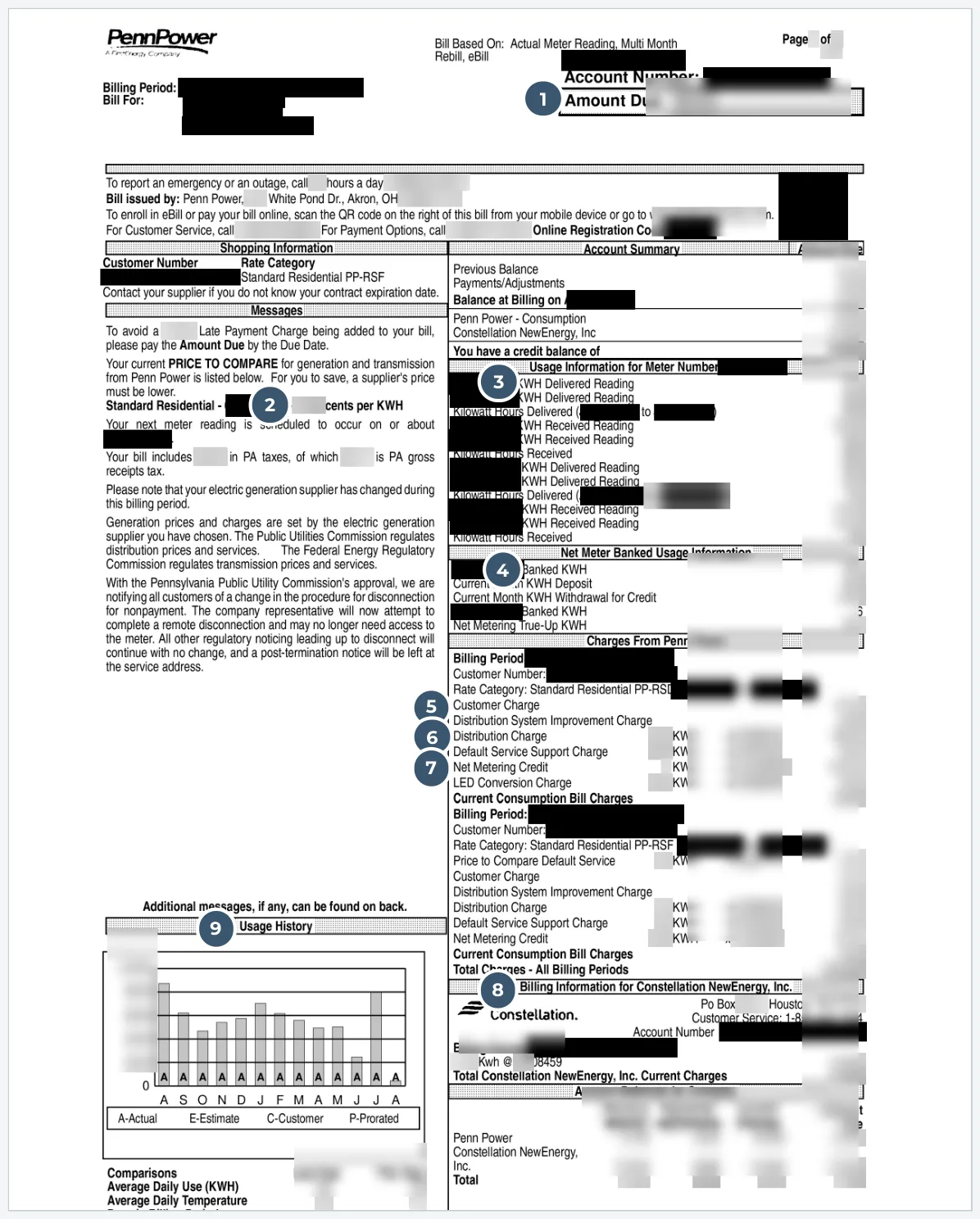
- Amount Due
What you owe this month.
- Price to Compare
What Penn Power charges per kWh if you don’t use an outside supplier. It updates on June 1 and December 1.
- Delivered vs. received
Delivered is power from the grid. Received is power your panels sent back.
- Banked kWh
Extra kWh saved for later months.
- Customer Charge
A flat monthly fee. You pay it with or without solar.
- Distribution Charge (delivery)
The per-kWh fee for bringing power over the utility’s wires. Net metering credits can offset kWh-based charges under your utility’s rules. The customer charge stays.
- Net metering credit
Your panels’ power taken off this month’s charges.
- Outside supplier
If you picked a supplier, its charges show as a separate section, and your supply credit comes from that supplier. Ask your supplier how it handles net metering credits.
- Usage history
Twelve months of usage.
How to read your Penelec bill
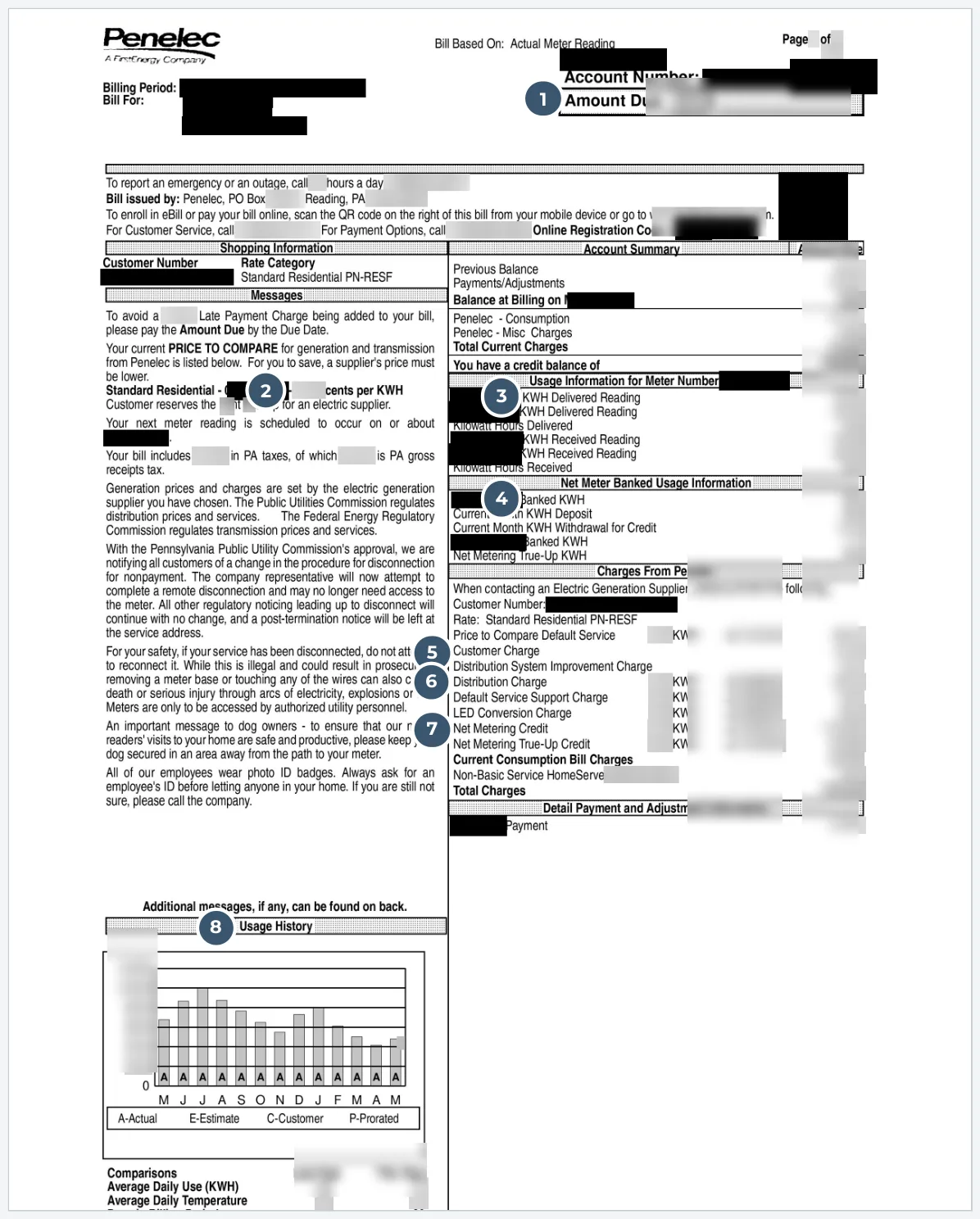
- Amount Due
What you owe this month.
- Price to Compare
What Penelec charges per kWh for generation and transmission. It updates on June 1 and December 1.
- Delivered vs. received
Delivered is power from the grid. Received is power your panels sent back.
- Banked kWh
Extra kWh saved for later months.
- Customer Charge
A flat monthly fee. You pay it with or without solar.
- Distribution Charge (delivery)
The per-kWh fee for bringing power over the utility’s wires. Net metering credits can offset kWh-based charges under your utility’s rules. The customer charge stays.
- Net metering credit and true-up
Your panels’ power taken off the charges, plus the yearly settle-up.
- Usage history
Twelve months of usage.
Guides cover the four utilities we have sample bills for. Price to Compare update dates: Duquesne Light and the FirstEnergy Pennsylvania utilities (West Penn Power, Penn Power, Penelec) on June 1 and December 1. Year-end credits: 52 Pa. Code 75.13. Questions about your own bill? Request an Interconnection Energy Report.